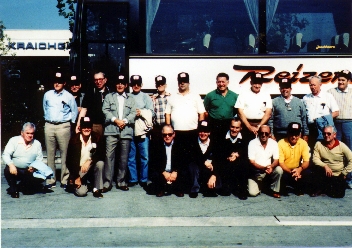
|
We left JKF Airport on Icelandic Airlines about 3:30 on Friday afternoon on what I thought was a non-stop flight to Paris. But after an hour or so in the air we started to descend, and, lo and behold, we landed in Iceland, where they gave us about an hour to check out the gift shops 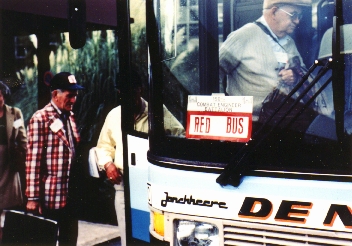
Then on to Paris, but it wasn't Paris; it was Luxembourg, where two luxury buses awaited us. One bus was blue; the other was red. Now they assigned the people from the l50th to the blue bus, except the sign in the windshield said "Red Bus". Now on to Caen, where we were assigned to a relative new motel. The other bus went to an older hotel, on the beach. It was midnight in Caen. We on the "Red Bus" felt a little cheated because the other bus was in an historic hotel, but after we met the people from the other bus later in the day we found out that while our continental breakfast was "all you could eat" of juice, croissants, coffee; the big hotel served one croissant, a small glass of juice, and one cup of coffee per person. Early Sunday morning we were introduced to the driver of the
"Red Bus" (which was blue). His name was Carlos, and he was from
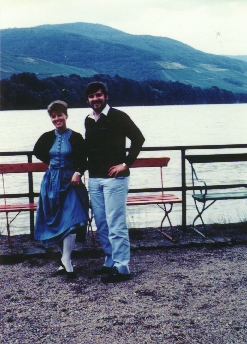
Belgium. Our tour guide was Agnes (pictured with Carlos on left) ;
a vivacious, pretty, petite schoolteacher from Switzerland, who
spoke several languages fluently. She guided tours We saw "Pegasus Bridge", which was taken on D-day by British
paratroopers, and because it was taken intact it allowed the
British to advance quicker than anticipated. We saw many monuments
erected in memory of British and American soldiers who gave their
lives for the liberation of France in 1944. One house had red,
white, and blue letters taped to the window, 'WELCOME TO OUR
LIBERATORS'. It is interesting to note that they were celebrating
the 40th anniversary of their liberation from the We visited the American military cemetery at Omaha Beach where
there are 9,385 crosses for soldiers of both World Wars (left).
From the vantage point of the cemetery we could look down on Omaha
Beach and see the cliffs that the Rangers had climbed on D-day
(below right), MONDAY Then we proceeded along a road near the ocean, trying to see if anything looked familiar. Many places did, but they weren't quite right; and then Borge and I both yelled, "THIS is where we came ashore!". We stopped the bus, and there was a sign depicting the landings, and we were on Red Fox Beach We read the information on the sign and agreed that this was the exact spot that we came ashore. We went to the water's edge, and most of us collected some sand to take home. Then we proceeded to Ste. Marie Eglise, I remember people wearing wooden shoes in the wet country near the coast when we were here in 1944, but they are not worn today. They wear rubber boots instead. We saw the hedgerows which hampered the advance of the troops in 1944. These hedgerows are used instead of fences, to separate fields in this rural area, and they are formed by piling dirt four or five feet high; then planting bushes along the top of the ridge. When Agnes was talking about the economy, she pointed out the abundance of cows, and added, "The immediate result of a milch cow is cheese!" From there we went to St. Lo, where we climbed up on the remains
of the old city wall. St. Lo was It was at St. Lo the Third Army was activated. In 1984 we
followed their route on to Avranches; then took a side trip to see
le Mont St. Michel. St. Aubert, Bishop of Avranches in the Eighth
Century, founded this huge monastery at the demand of St. Michel,
who appeared to him twice in a vision and demanded a chapel be
built in his honor on this high rock which is actually an island
at high tide. It was at Avaranches that General Patton began the terrific advance which smashed the German offensive from Mortain. By the time the Germans organized their counter attack, the 150th was already at St. Hilaire, and we realized we had had a close call at Avranches. Our bus went on to Mortain, Vire, Villers, Bocage; then back to the hotel at Caen. (Picture right) TUESDAY Our hotel in Paris was not in Paris, but twenty miles north, in the cornfields. Those who planned to spend the night on the town were disappointed, especially two couples celebrating their wedding anniversaries! Agnes and Carlos contacted their headquarters in Switzerland and got permission to take us into Paris for the evening. Paris has changed alot. The tour guide warned us about groups of children who would beg for money and rip you off if they had a chance. We stopped at the overlook to the Eiffel Tower and were accosted by Moraccans who had stuff to sell and almost forced you to buy it. WEDNESDAY Napoleon sure built a beautiful palace and grounds; a work of art. Then on to Versailles(left) and lunch in an outdoor cafe. The castle is breathtaking. There is so much there it is hard to describe without spending volumes on it. The interior is a work of art, all over; everywhere you look. And the grounds with the gardens, the paths, the reflecting pools, and the waterfalls; we did not have time to really get to see all of the grounds. We especially admired the statues, which were everywhere.
THURSDAY We spend three hours eating our evening meal. One waiter came around and asked each person for his/her cheese order, which he then prepared and served. Then he came around and asked for our wine order, which he also served. About then, it was time for them to serve us the meal, which the one waiter served. We were getting a little impatient by the time dessert came. We learned that this is how it's done in France. FRIDAY The cathedral at Reims constructed between the twelfth and
fourteenth centuries, In Verdun we saw the inspiration for the Engineer symbol, the castle, on a city gate built by Louis XIV (Picture, left). World War I battlefields in this area have been left undisturbed in a memorial park, but trees and bushes hide the uneven contours of shell holes. Here there were underground 'galleries' in the mountains, where citizens took refuge during the battles. In 1944, many of us picked up fur jackets in Verdun. We passed by the World War I monument and museum on our way to our hotel in Metz. It was a nice hotel; normal slow service at dinner. SATURDAY In 1944 we took out a roadblock in Chateau-Salins and the Fourth Armored went in and took over the area. We then pulled back into the Champaneaux Forest where we spent six weeks waiting for gasoline. We didn't exactly wait. Our mission was to keep the main supply roads open, and we walked miles and miles, replacing roads. We also took in replacements there. In 1984, we found the site where we had removed the roadblock, but we couldn't spot the farm where we chased chickens and turkeys with helmets, knives, etc. We had given the loot to the cooks, who prepared a nice chicken dinner for the troops. We kept the butter we had liberated, and fried some of the fowl to keep in reserve for snacks. After six weeks, we went back into Chateau-Salins, where we were
bivouacked up on a hill overlooking what we thought was the entire
Fourth Armored Division so we felt very safe.. We dug foxholes,
and I was sitting on my In 1984 we stopped in Gramacey where we held a memorial services (left) for the three men who were killed in this area: Carl Fryback, James Cassidy, and Jimmy Kasmir. When we finished our ceremony, three doves flew over us as we stood on the steps of the chapel. We noticed in the Battalion History the 150th passed through here on September 23, 1944. We were here again on September 22, 1984! SUNDAY The people of Luxembourg observe Liberation Day July 10th in
gratitude to the Anerican and British troops who gave their lives
for freedom. The church We got back into the buses and went to Clerveaux for lunch. On
the way we found another bridge site in Lipperschied where A
Company built a 120-foot Double-double Bailey. In Clerveaux we saw
another monument which had been Crowd at Museum Dedication in Diekirch On the way back to Luxembourg City, as we bypassed a small village, Borge called me and said, "Hey Norm! That's where we stayed in Mersch." One night when we came back to the house after putting in a bridge, the lady of the house had made a nice, hot barley soup, and boy, it tasted good! As we approached Luxembourg City we saw a large modem concrete and steel bridge, and Agnes, in her sweet accent said, "Und you built THAT one, too, I suppose?" While we were in Mersch in 1944 the Quartermaster Corps had set
up a shower down by a river. We had left Sarguimines with the
Third Army and had been on the road for something like six weeks
working under cold, MONDAY In Malmedy we stopped at the memorial to the American prisoners who were murdered there by the Germans. (Picture, right). Then we persuaded the Colonel, and Agnes, and Carlos to take us
to that little town called Hoesdorf where the 150th put the 80th
Division across the flooded Sauer River in assault boats under
cover of darkness, under fire, after several failed attempts to
build a bridge. The Colonel The Colonel said, "Due to time restraints, we will say a little
prayer outside the bus, and then go on." We had a different idea.
As the doors of the bus opened, we headed down into the tiny
village and into the cemetery, (left) where we could view the
apple orchard (below) and the river that we had seen only at night
until this day. We met a lady whose mother had told her what we had done there. We persuaded Agnes to come down and interpret as we conversed. When we got back on the bus, most of the men agreed that was,
for us, the high point of our trip to Europe. As they took turns
at the TUESDAY On Tuesday we entered Germany. Trier is Germany's oldest city,
dating from the first century before Christ. A Roman bridge is
still in use on a main road of the town. After Trier, going
towards our hotel in Koblenz, we traveled a Roman road built by
Constantine; very narrow, through a tiny village in the Mosel
valley, heading for a bridge site at Moselkern. What a change as we crossed the border into Germany. Everything was fast. At our hotel in Koblenz our evening dinner took half an hour, from salad through dessert, and was just as elegant and delicious as the three-hour dinners in France! We went up to our room on the top floor. It had been completely renovated, with sky-lights and wood paneling. Opening the skylight, we could look out at the Mosel River. The beds were single beds, immaculately done up, with one quilt--an eider puff, actually--that was shorter than I am and not much wider. The temperature was such that you needed some cover, but not that much; so all night you were hanging an arm or a leg out from under the covers, trying to cool down. WEDNESDAY At Oppenheim we saw (in 1984) the modern army's bridging already in place at the sides of the Rhine. All they had to do was move it into position and tie it together. We changed money there in a bank; then we went for a ride down the Rhine on an excursion boat. We went past the Loreley, and saw many castles. THURSDAY Then we went on to Regensburg where we were billeted in that
German artillery outfit and rode horses through the bombed out
aircraft factory buildings. Faile and I were on detached service
with an artillery unit working with German POW'S. One of them cut
his SS tattoo out from under his arm with his pocketknife! In Straubing we found our bridge site by remembering One day I asked Colonel Reagan why he was always walking around with packets of vegetable seeds. He was giving them to the German people because they are almost impossible to buy over there. You have to grow your own seeds. We stopped in Heidelberg and saw the ruins of Heidelberg Castle. At Saarbrucken we held a farewell party. At Luxembourg Airport we said goodbye to Carlos and Agnes, and the red bus which was blue We enjoyed our fortieth anniversary battle sites tour, but I have always wished we had had a driver from the 150th with us. During the war, we could only see where we had been, from the back of the trucks; not where we were going! As it was, we picked up a bit of culture, and Agnes and Carlos learned a bit about combat veterans. |
 during school vacations and was well trained in
touring cathedrals, castles, and museums; but not battlefields!
during school vacations and was well trained in
touring cathedrals, castles, and museums; but not battlefields! 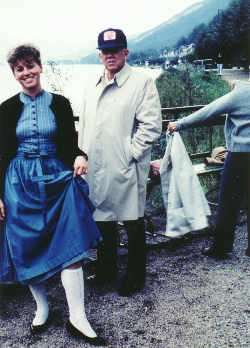 She
and Colonel Reagan had a number of confrontations as to where and
when we would go on any given day. (Agnes with Norm on the right)
She
and Colonel Reagan had a number of confrontations as to where and
when we would go on any given day. (Agnes with Norm on the right)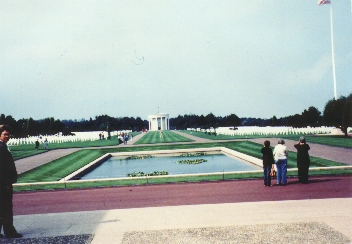 German occupation, rather than celebrating VE Day,
May 1945. We learned that, because of tides and weather
conditions, if D-day couldn't have happened June 6, 1944, it would
have had to be put off another whole month.
German occupation, rather than celebrating VE Day,
May 1945. We learned that, because of tides and weather
conditions, if D-day couldn't have happened June 6, 1944, it would
have had to be put off another whole month. 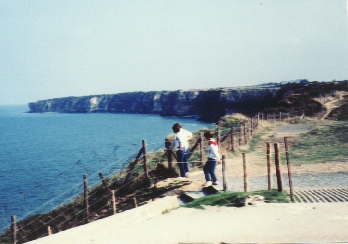 and what
remained of the British artificial harbors that were still in the
water. We could also see what looked like small houses but were
really German fortifications. (Below left)
and what
remained of the British artificial harbors that were still in the
water. We could also see what looked like small houses but were
really German fortifications. (Below left) 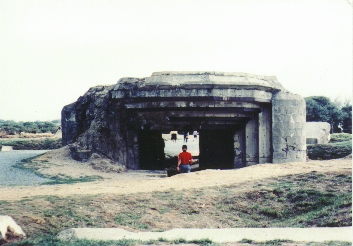
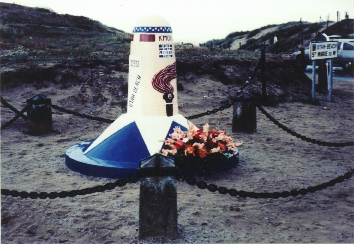 Every kilometer there is a monument. It is about
three feet high, made of concrete, and looks like a bomb with the
fins down, with red white and blue stripes; and it tells how far
it is from Utah Beach.
Every kilometer there is a monument. It is about
three feet high, made of concrete, and looks like a bomb with the
fins down, with red white and blue stripes; and it tells how far
it is from Utah Beach.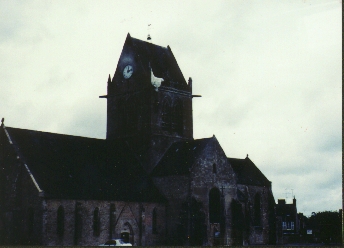 the first French
village to be liberated during the invasion. To commemorate the
40th anniversary of the liberation, a parachute had been hung on
the steeple of the cathedral. At this cathedral, a paratrooper
hung on the steeple twelve hours and played dead, until the Allied
Forces had taken the village. It is a twelfth century church which
has been partially rebuilt. A stained glass window has been
erected in memory of the liberation. The window shows the Virgin
Mary surrounded by paratroopers.
the first French
village to be liberated during the invasion. To commemorate the
40th anniversary of the liberation, a parachute had been hung on
the steeple of the cathedral. At this cathedral, a paratrooper
hung on the steeple twelve hours and played dead, until the Allied
Forces had taken the village. It is a twelfth century church which
has been partially rebuilt. A stained glass window has been
erected in memory of the liberation. The window shows the Virgin
Mary surrounded by paratroopers.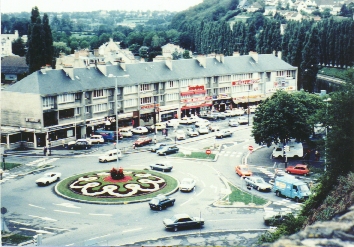 totally destroyed
by bombs during World War II. The Germans had taken a stand there,
and allied forces were held up on the beaches until bombers came
to destroy the German stronghold. The bombers were directed by
smoke bombs fired by the Infantry to show the location of their
front lines, but smoke drifted back over allied lines and the
bombers dropped their loads too soon. Reserve troops had to be
brought forward because two divisions had been made ineffective
because of the bombing. The 150th had escaped that disaster, but
we went through St. Lo when it was still burning, on roads
bull-dozed through the rubble. (St. Lo in 1984, from the city
wall, above)
totally destroyed
by bombs during World War II. The Germans had taken a stand there,
and allied forces were held up on the beaches until bombers came
to destroy the German stronghold. The bombers were directed by
smoke bombs fired by the Infantry to show the location of their
front lines, but smoke drifted back over allied lines and the
bombers dropped their loads too soon. Reserve troops had to be
brought forward because two divisions had been made ineffective
because of the bombing. The 150th had escaped that disaster, but
we went through St. Lo when it was still burning, on roads
bull-dozed through the rubble. (St. Lo in 1984, from the city
wall, above) Today it is a network of old buildings forming a
tiny village, yet it is one building.
Today it is a network of old buildings forming a
tiny village, yet it is one building.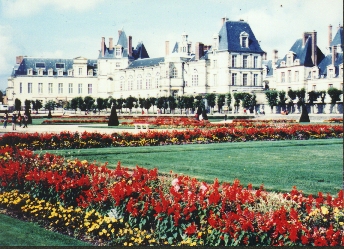 and off at 7:45 a.m. to keep our appointment for a castle tour in
Fontainbleau!
and off at 7:45 a.m. to keep our appointment for a castle tour in
Fontainbleau!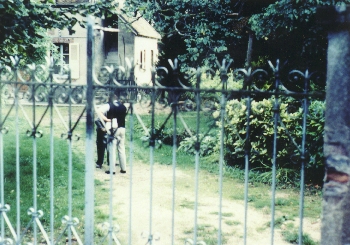 At Truezy, near
Nemours, we found the exact field where the 150th bivouacked in
1944. An old man who was there wouldn't let us get out and look
around because the owner wasn't home. Apparently the owner is the
grandson of the Baron and Baroness who were so gracious in 1944.
At that time the couple wanted to invite our officers into their
home for dinner, but they had no food. The officers talked to our
cooks, and the cooks gave them enough food to feed the group and
delivered it to the chateau where it was prepared and served
French-style.
At Truezy, near
Nemours, we found the exact field where the 150th bivouacked in
1944. An old man who was there wouldn't let us get out and look
around because the owner wasn't home. Apparently the owner is the
grandson of the Baron and Baroness who were so gracious in 1944.
At that time the couple wanted to invite our officers into their
home for dinner, but they had no food. The officers talked to our
cooks, and the cooks gave them enough food to feed the group and
delivered it to the chateau where it was prepared and served
French-style. 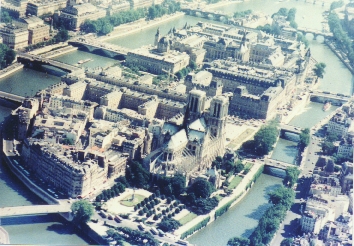 It began in the first century BC, on an island in the Seine. Lucy
and I left the group, walked up the Champs d'Elysses; looked at
L'Opera, Piguale, Montmarte, and stopped at a little cafe to have
lunch. We sat down and looked at the menu, which was in French.
When the lady at the next table heard our conversation she asked
if she could help us. She had been in the French Underground
during World War II, and she thanked me for having come to help
liberate France. She knew exactly what she wanted, and had ordered
and eaten and another had taken her place before we were ready to
leave. When the second woman overheard our difficulty with the
French money, she offered to help. We were surprised at the
kindness that were shown us by complete strangers. The cafe was
directly across the street from a Christian Dior shoppe.
It began in the first century BC, on an island in the Seine. Lucy
and I left the group, walked up the Champs d'Elysses; looked at
L'Opera, Piguale, Montmarte, and stopped at a little cafe to have
lunch. We sat down and looked at the menu, which was in French.
When the lady at the next table heard our conversation she asked
if she could help us. She had been in the French Underground
during World War II, and she thanked me for having come to help
liberate France. She knew exactly what she wanted, and had ordered
and eaten and another had taken her place before we were ready to
leave. When the second woman overheard our difficulty with the
French money, she offered to help. We were surprised at the
kindness that were shown us by complete strangers. The cafe was
directly across the street from a Christian Dior shoppe. 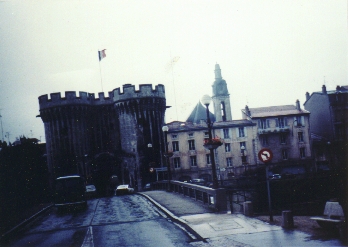 was where the kings
and queens of France were baptized All French kings were crowned
in this cathedral. The surrender of the Germans was accepted here
on May 7, 1945. We visited champagne caves in Moet, where 70
million bottles of champagne lie aging in the 18 miles of caves.
was where the kings
and queens of France were baptized All French kings were crowned
in this cathedral. The surrender of the Germans was accepted here
on May 7, 1945. We visited champagne caves in Moet, where 70
million bottles of champagne lie aging in the 18 miles of caves.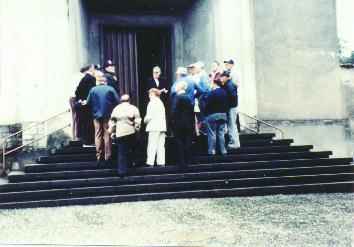 foxhole writing a
letter to Lucy when my peripheral vision picked up an artillery
burst off to the left; then one to the right. I got into my
foxhole, and the next shell landed in the foxhole next to me,
killing Carl Fryback.
foxhole writing a
letter to Lucy when my peripheral vision picked up an artillery
burst off to the left; then one to the right. I got into my
foxhole, and the next shell landed in the foxhole next to me,
killing Carl Fryback.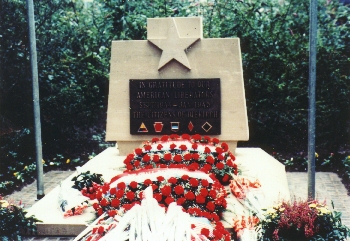 was already filled
when we arrived, and two more busloads made "standing room only".
After the mass, in spite of the pouring rain, the entire
congregation marched to the monument in a lovely park filled with
roses. There we listened to speeches by the lady mayor and the
U.S.Ambassador to Luxembourg before the unveiling of the monument.
All veterans
was already filled
when we arrived, and two more busloads made "standing room only".
After the mass, in spite of the pouring rain, the entire
congregation marched to the monument in a lovely park filled with
roses. There we listened to speeches by the lady mayor and the
U.S.Ambassador to Luxembourg before the unveiling of the monument.
All veterans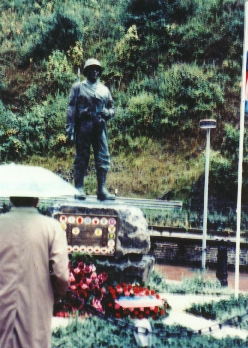 and their guests
were invited to a wine reception in City Hall.
and their guests
were invited to a wine reception in City Hall. 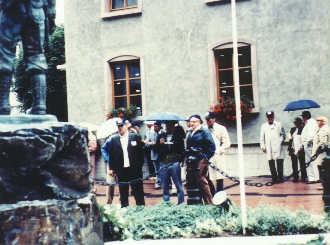 dedicated just the
day before "To our Liberators" (above right). What a pretty town,
way down in a valley, with no autos allowed in the center of the
village. Later we returned to Diekirch for the dedication of the
new World War II museum. Colonel Reagan had donated a number of
artifacts.(Right; Some of the members of the 150th; Clerveaux
1984)
dedicated just the
day before "To our Liberators" (above right). What a pretty town,
way down in a valley, with no autos allowed in the center of the
village. Later we returned to Diekirch for the dedication of the
new World War II museum. Colonel Reagan had donated a number of
artifacts.(Right; Some of the members of the 150th; Clerveaux
1984)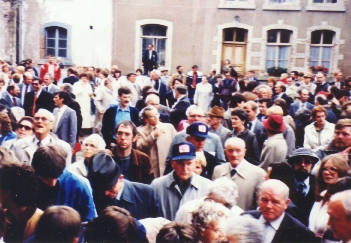
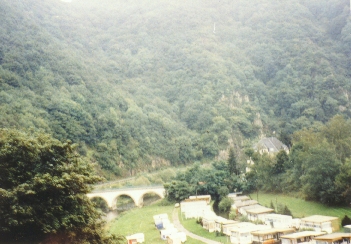 wet dirty
conditions with no time for personal hygiene. A platoon at a time
went to the showers. There you stripped down, leaving all your
clothes except your personal items and your boots. You were given
soap and a towel; and oh, that hot water felt good! When you were
clean you were given a complete set from the skin out, of CLEAN
CLOTHES. You put on your clothes, put on your boots, took your
personal items and got on the truck to go back to Merch. (Picture
is location of showers in Mersch in 1944). This
quartermaster shower is mentioned in the book THE DAMNED ENGINEERS
by Janice Holt Giles.
wet dirty
conditions with no time for personal hygiene. A platoon at a time
went to the showers. There you stripped down, leaving all your
clothes except your personal items and your boots. You were given
soap and a towel; and oh, that hot water felt good! When you were
clean you were given a complete set from the skin out, of CLEAN
CLOTHES. You put on your clothes, put on your boots, took your
personal items and got on the truck to go back to Merch. (Picture
is location of showers in Mersch in 1944). This
quartermaster shower is mentioned in the book THE DAMNED ENGINEERS
by Janice Holt Giles. 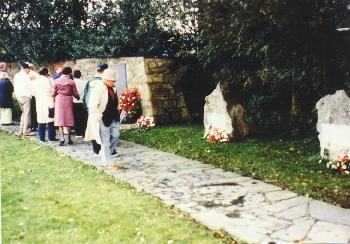 General McAuliffe
gave his answer to the demand for surrender: "Nuts!". The entire
city was destroyed in the battle.
General McAuliffe
gave his answer to the demand for surrender: "Nuts!". The entire
city was destroyed in the battle. 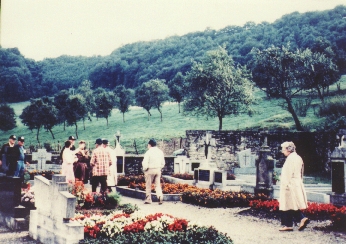 had not been
involved in that mission, so didn't understand why it meant so
much to us, and it was only after Hoesdorf that Agnes understood
that our group was NOT in Europe to see castles and cathedrals!
had not been
involved in that mission, so didn't understand why it meant so
much to us, and it was only after Hoesdorf that Agnes understood
that our group was NOT in Europe to see castles and cathedrals! 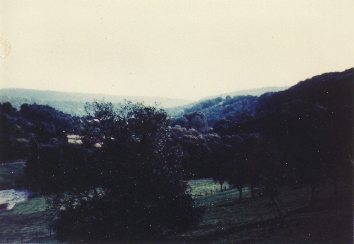 The Seigfried Line
across the river was gone. All the pillboxes and bunkers from
which the enemy fire came had been destroyed and removed.
The Seigfried Line
across the river was gone. All the pillboxes and bunkers from
which the enemy fire came had been destroyed and removed. 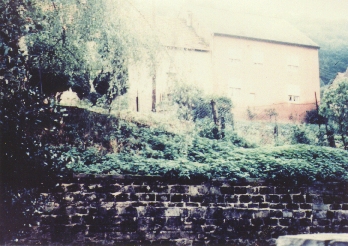 microphone they
described how vulnerable they had felt as they took the assault
boats down that brilliantly lighted hillside to the water under
heavy artillery fire from across the river; and as they came back
from across the river with prisoners to seek shelters in the
cellars of the village houses. (like pictured at left). "It felt
like they were all aiming at me."
microphone they
described how vulnerable they had felt as they took the assault
boats down that brilliantly lighted hillside to the water under
heavy artillery fire from across the river; and as they came back
from across the river with prisoners to seek shelters in the
cellars of the village houses. (like pictured at left). "It felt
like they were all aiming at me." 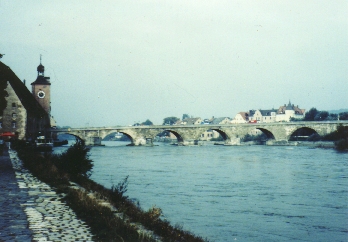 of Regensburg on the
Danube by boat, then had lunch on an Austrian steamer built in
1865. The medieval stone arch bridge in Regensburg (pictured left)
is the longest in the world. It has fifteen arches. In Colonel
Reagan's ODYSSEY WITH PATTON he states that most of the officials
we worked with here were elderly and maimed or disfigured from the
war. One reported that when the German SS troops were scorching
the earth near the end of the war the citizens tried to prevent
destruction of their old stone arch bridge. In answer, half the
town council was gunned down in front of the others, and part of
the bridge was destroyed.
of Regensburg on the
Danube by boat, then had lunch on an Austrian steamer built in
1865. The medieval stone arch bridge in Regensburg (pictured left)
is the longest in the world. It has fifteen arches. In Colonel
Reagan's ODYSSEY WITH PATTON he states that most of the officials
we worked with here were elderly and maimed or disfigured from the
war. One reported that when the German SS troops were scorching
the earth near the end of the war the citizens tried to prevent
destruction of their old stone arch bridge. In answer, half the
town council was gunned down in front of the others, and part of
the bridge was destroyed. 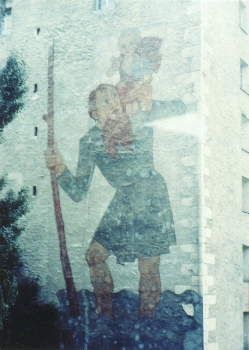 a mural on the wall of a building; still there,
forty years later! The war was over when we built this one. It was
built for two reasons:
a mural on the wall of a building; still there,
forty years later! The war was over when we built this one. It was
built for two reasons: 